Choosing the right CRM can feel overwhelming, especially when you’re weighing giants like Zoho, Salesforce, and HubSpot. Each promises to boost your sales, streamline your marketing, and keep your customer relationships thriving—but which one really fits your unique needs?
You want a system that works smoothly, doesn’t break the bank, and grows with your business. You’ll discover clear, straightforward insights comparing Zoho, Salesforce, and HubSpot. By the end, you’ll know exactly which CRM matches your goals and why. Ready to make the smartest choice for your business?
Keep reading—your perfect CRM solution is just ahead.
Crm Market Leaders
The CRM market hosts several powerful tools, with Salesforce, Zoho, and HubSpot leading the way. Each platform offers unique strengths that suit different business needs. Understanding these leaders helps companies choose the right CRM for growth and efficiency.
Salesforce Highlights
Salesforce stands out with advanced AI and automation features. It offers deep predictive analytics to forecast sales trends. Large enterprises often choose Salesforce for its scalability and robust integrations. The platform supports complex workflows and custom apps. Users benefit from a vast ecosystem and strong support.
Zoho Strengths
Zoho CRM is known for its customization and cost-effectiveness. It allows users to tailor fields, modules, and workflows easily. Zoho integrates well with its business apps like Books and Desk. This CRM suits small to mid-size businesses seeking value and flexibility. It has a steeper learning curve but offers great control.
Hubspot Focus
HubSpot prioritizes ease of use and marketing automation. Its interface is intuitive, enabling quick setup and adoption. The platform excels in inbound marketing and sales alignment. Small businesses and startups often prefer HubSpot for its all-in-one solution. HubSpot’s tools help streamline marketing, sales, and service teams.
Core Features Comparison
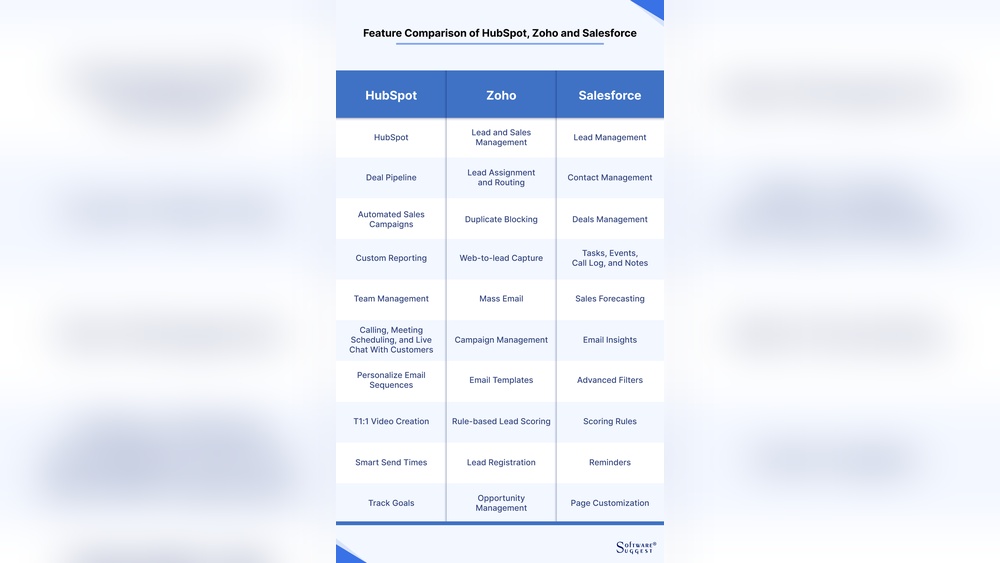
Understanding the core features of Zoho, Salesforce, and HubSpot helps choose the right CRM. Each platform offers unique tools that suit different business needs. Comparing customization, automation, interface, and integrations reveals their strengths and limits.
Customization Options
Zoho provides deep customization with flexible fields and modules. Businesses can tailor workflows and layouts to match processes. Salesforce excels in advanced customization, allowing complex rule creation and app building. HubSpot offers simpler customization, focusing on ease of use. It suits companies wanting quick setup without complex changes.
Automation Capabilities
Salesforce leads with powerful automation, including AI-driven tasks and predictive analytics. Zoho offers solid automation for routine tasks and lead management but with fewer AI features. HubSpot emphasizes marketing automation, making it easy to nurture leads and automate emails. It fits marketing teams aiming for inbound growth.
User Interface And Experience
HubSpot shines with a clean, intuitive interface that new users find friendly. Zoho has a comprehensive interface but may feel crowded due to many features. Salesforce’s interface is robust but can be complex for beginners. Each platform balances functionality and user experience differently.
Integration Ecosystems
Salesforce supports thousands of third-party apps, making it highly extendable. Zoho offers strong integration within its own suite of business apps, creating a seamless ecosystem. HubSpot integrates well with popular marketing and sales tools, focusing on smooth data flow. Choice depends on existing tools and desired connectivity.
Pricing And Value
Choosing between Zoho, Salesforce, and HubSpot often depends on how each platform handles pricing and the value it offers. Budget matters for small and large businesses alike. Understanding cost differences helps in picking the right CRM without overspending. Each CRM has unique pricing models that suit different business needs and sizes.
Cost Structures
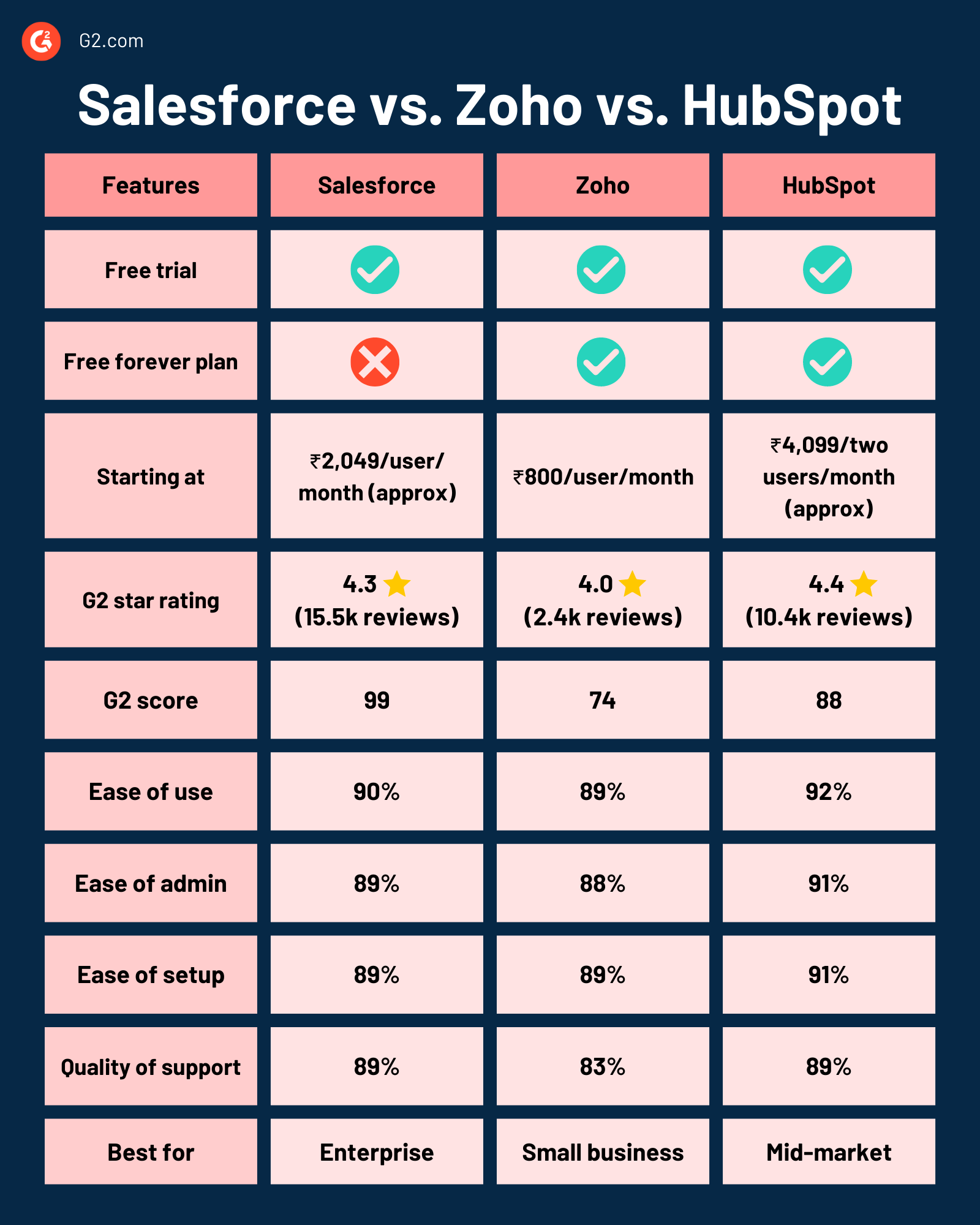
Zoho offers tiered pricing with plans starting low. Salesforce follows a per-user, per-month model with higher starting costs. HubSpot provides modular pricing based on features needed. Zoho’s pricing often suits small businesses or startups. Salesforce targets enterprises with a wide range of advanced features. HubSpot’s plans scale with marketing, sales, and service tools.
Free And Trial Options
Zoho CRM includes a free plan with basic features for small teams. Salesforce offers a free trial but no permanent free plan. HubSpot provides a free tier with core CRM functions. These free options help businesses test the software before buying. HubSpot’s free version is popular for its user-friendly setup. Zoho’s free plan supports simple CRM needs effectively.
Scaling Expenses
As businesses grow, Zoho’s pricing stays affordable but adds costs with more users. Salesforce’s costs rise significantly with added features and users. HubSpot can become expensive when adding marketing and sales tools. Each CRM requires budgeting for future expansion. Zoho offers value for companies needing customization at scale. Salesforce suits firms needing complex solutions and advanced analytics. HubSpot works well for marketing-driven businesses increasing tool usage over time.

Credit: www.softwaresuggest.com
Target Users
Choosing the right CRM depends greatly on the type of users and their unique business needs. Zoho, Salesforce, and HubSpot each serve different audiences with specific features tailored to their demands. Understanding the target users helps businesses pick a CRM that fits their size, complexity, and marketing focus.
Small To Medium Businesses
Zoho suits small to medium businesses best. It offers affordable pricing and flexible customization. These companies often need an all-in-one system that grows with them. Zoho provides essential tools without overwhelming new users. HubSpot also appeals to SMBs with its easy setup and user-friendly design. It helps teams manage sales and marketing without extra training. Salesforce may be too complex and costly for smaller firms.
Enterprise Needs
Salesforce targets large enterprises with complex demands. It supports advanced automation, AI, and extensive integrations. Big companies require a CRM that handles large data and many users. Salesforce offers scalability and customization to meet these needs. Zoho can serve mid-sized firms but may lack some high-end features. HubSpot’s enterprise solutions exist but focus more on marketing than deep sales management.
Marketing-driven Companies
HubSpot fits marketing-driven companies perfectly. It emphasizes inbound marketing tools, lead nurturing, and content management. Marketing teams benefit from its seamless integration of marketing and sales. HubSpot’s CRM is designed to align campaigns and sales pipelines. Zoho has marketing features but less focus on inbound strategies. Salesforce supports marketing teams but often requires additional products and setup.
Ease Of Setup And Learning
Choosing the right CRM depends a lot on how easy it is to set up and learn. A smooth start saves time and reduces frustration. Each platform—Zoho, Salesforce, and HubSpot—offers a different experience in setup and learning. Understanding these differences helps find the best fit for your team.
Onboarding Experience
HubSpot stands out for its quick and simple onboarding. It guides users step-by-step with clear instructions. Zoho provides more options during setup, which takes longer but allows deeper customization. Salesforce offers a powerful but complex onboarding process that suits larger teams with specific needs.
Learning Curve
HubSpot has a gentle learning curve, making it easy for beginners. Zoho’s many features create a steeper learning curve. Users need time to explore all options. Salesforce is the most complex, requiring more training. It suits users ready to invest in learning advanced tools.
Support And Resources
All three platforms offer strong support and learning materials. HubSpot provides a rich library of tutorials and an active community. Zoho offers detailed guides and webinars for deeper understanding. Salesforce has extensive resources, including certification programs and expert help.

Credit: closeloop.com
Sales And Marketing Alignment
Aligning sales and marketing teams improves business growth and customer experience. It creates smooth communication and shared goals. Efficient alignment boosts lead quality and shortens sales cycles. Choosing the right CRM platform supports this harmony by bridging gaps between teams.
Hubspot’s Inbound Marketing Strength
HubSpot excels in inbound marketing tools that attract and nurture leads. It offers easy-to-use content creation, email marketing, and social media management. Sales teams get real-time lead insights and engagement data. This clear visibility helps teams focus on qualified prospects. HubSpot’s platform unites marketing and sales workflows in one place.
Salesforce’s Ai And Analytics
Salesforce uses AI to provide predictive lead scoring and sales forecasting. Its analytics offer deep insights into customer behavior and campaign performance. Marketing and sales get data-driven recommendations to improve strategies. Automated alerts ensure timely follow-ups with leads. Salesforce helps teams make smarter decisions based on real data.
Zoho’s Workflow Customization
Zoho CRM allows businesses to customize workflows to fit their unique sales processes. Automation rules streamline tasks like lead assignment and follow-up reminders. Marketing and sales teams can create shared pipelines and track activities together. This flexibility enhances collaboration and reduces manual work. Zoho adapts easily to different business needs and sizes.
Automation And Ai
Automation and AI play a vital role in modern CRM systems. They help businesses save time and improve customer engagement. Each platform uses these technologies differently. Let’s examine how Salesforce, Zoho, and HubSpot handle automation and AI.
Salesforce Einstein Features
Salesforce Einstein offers advanced AI tools built into the CRM. It provides predictive analytics to forecast sales and customer behavior. The Einstein Assistant helps automate tasks like scheduling and follow-ups. It also analyzes data to give smart recommendations. Einstein enhances decision-making with deep learning and natural language processing.
Zoho Basic Ai Tools
Zoho CRM includes basic AI features called Zia. Zia can detect anomalies in data and suggest the best time to contact customers. It automates routine tasks and helps with lead scoring. Zoho’s AI focuses on improving efficiency without complexity. It suits small to medium businesses that want simple automation.
Hubspot Marketing Automation
HubSpot uses automation mainly for marketing workflows. It automates email campaigns, lead nurturing, and customer segmentation. HubSpot’s AI optimizes send times and content for better engagement. Its user-friendly design makes setting up automation easy. HubSpot helps marketing teams save time and target customers effectively.
Integration And Ecosystem
Integration and ecosystem play a crucial role in CRM success. They define how well a CRM connects with other tools. They also show the range of apps and services that work together smoothly. Choosing a CRM with a strong ecosystem improves workflow and saves time. It allows businesses to manage many tasks from one place. Here is a look at Zoho, Salesforce, and HubSpot’s integration and ecosystems.
Zoho’s Business Suite
Zoho offers a broad business suite with over 40 apps. These apps cover sales, marketing, finance, and customer support. The apps are tightly integrated for smooth data flow. Users can connect Zoho CRM with Zoho Books, Projects, and Desk easily. This creates a unified experience without switching platforms.
Zoho also supports third-party integrations through APIs and Zapier. This allows connection to popular tools like Google Workspace and Microsoft 365. The built-in automation features link apps and reduce manual work. Zoho’s ecosystem suits companies needing an all-in-one solution at a low cost.
Salesforce Appexchange
Salesforce’s AppExchange is one of the largest CRM app stores. It offers thousands of apps and components. These add functions like analytics, marketing, and customer service. Businesses can tailor Salesforce with apps that fit their needs exactly.
Salesforce integrates well with many enterprise tools. It supports ERP, email, and social media platforms. The API and developer tools enable deep customizations and complex workflows. This ecosystem fits large businesses wanting flexible, scalable solutions. It also helps teams build apps specific to their industry or process.
Hubspot Hubs Ecosystem
HubSpot organizes its platform into Hubs: Marketing, Sales, Service, CMS, and Operations. Each Hub works well alone or combined with others. The Hubs share data and features for a seamless user experience.
HubSpot connects easily with common tools like Gmail, Outlook, Shopify, and Slack. The App Marketplace offers many third-party integrations. HubSpot’s focus is simplicity and ease of use. Its ecosystem supports small to mid-sized businesses focused on inbound marketing and customer growth.
Choosing The Right Crm
Choosing the right CRM system is crucial for business growth and customer management. The best CRM matches your company’s size, budget, and goals. Each platform offers unique features and benefits. Understanding these helps you make a smart choice. Zoho, Salesforce, and HubSpot stand out as top options. They serve different needs and industries. This section breaks down when to pick each CRM.
When To Pick Zoho
Choose Zoho if your budget is tight but needs are complex. Zoho offers strong customization for fields, modules, and workflows. It works well for businesses wanting a full suite of integrated apps. Zoho fits companies that want control over every CRM detail. It suits teams ready to invest time in setup and learning. Zoho’s automation and integration with its own tools add value. Expect a learning curve but gain flexible, affordable CRM power.
When To Pick Salesforce
Salesforce fits large businesses or those needing advanced features. It offers robust AI, automation, and predictive analytics. Choose Salesforce for deep customization and scalability. It supports complex sales processes and global teams. Salesforce integrates well with many third-party apps and platforms. The system suits companies wanting detailed reporting and high security. It demands higher investment but delivers enterprise-level CRM strength.
When To Pick Hubspot
HubSpot is ideal for small to medium businesses focused on marketing. Its user-friendly interface allows quick setup and ease of use. HubSpot excels in marketing automation and inbound sales alignment. Choose HubSpot if your team values simplicity and fast adoption. It supports growth through built-in tools for sales, marketing, and customer service. HubSpot fits businesses that want an all-in-one platform without complexity.
Credit: www.g2.com
Frequently Asked Questions
Is Zoho Better Than Salesforce?
Zoho suits budget-conscious businesses needing deep customization and integrated apps. Salesforce excels with advanced AI, automation, and predictive analytics. Choose Zoho for affordability and flexibility; pick Salesforce for robust features and scalability. Both serve different business needs effectively.
Who Is The No. 1 Crm Provider?
Salesforce is the number one CRM provider globally, known for advanced AI, automation, and predictive analytics. It leads market share and innovation.
Which Crm Is Better, Zoho Or Hubspot?
Zoho CRM suits businesses needing deep customization and affordability. HubSpot offers user-friendly marketing automation and quick setup. Choose Zoho for granular control and budget value. Pick HubSpot for ease of use and seamless marketing-sales alignment. Both excel in different areas based on your business needs.
Why Are Companies Leaving Salesforce?
Companies leave Salesforce due to its high costs, complex customization, lengthy implementation, and preference for more user-friendly or affordable CRM alternatives.
Conclusion
Choosing between Zoho, Salesforce, and HubSpot depends on your business needs. Zoho fits those needing customization and budget-friendly options. Salesforce works well for companies wanting advanced features and analytics. HubSpot suits businesses valuing ease of use and marketing tools. Each platform offers unique strengths and trade-offs.
Think about your priorities before deciding. This ensures the best fit for your growth and daily tasks.