Choosing the right marketing automation tool can make or break your business growth. If you’re torn between Pardot and HubSpot, you’re not alone.
Both platforms offer powerful features, but which one truly fits your needs? You want a solution that’s easy to use, integrates smoothly, and won’t drain your budget. HubSpot stands out with its intuitive interface, built-in CRM, and a suite of tools designed specifically for startups and small businesses like yours. Plus, it’s 100% free with no expiration, giving you a risk-free way to unify your customer data and boost your marketing efforts. Ready to find out why HubSpot might be the better choice for your business? Dive in and discover the key differences that will help you make the smartest decision for your growth. Check out HubSpot here: HubSpot CRM Software
Introduction To Pardot And Hubspot
Pardot and HubSpot are two popular marketing automation platforms. Both help businesses manage customer relationships and marketing campaigns. Each platform offers unique tools and features suited for different needs. This section introduces Pardot (now Salesforce Marketing Cloud Account Engagement) and HubSpot, covering their key aspects and target users.
Overview Of Pardot (now Salesforce Marketing Cloud Account Engagement)
Pardot was rebranded as Salesforce Marketing Cloud Account Engagement. It is a B2B marketing automation tool designed to connect marketing and sales teams.
- Focuses on lead generation and nurturing
- Deep integration with Salesforce CRM
- Offers email marketing, lead scoring, and ROI reporting
- Designed for medium to large businesses with complex sales cycles
Pardot helps companies automate repetitive tasks and track customer interactions. Its features support detailed campaign management and personalized marketing.
Overview Of Hubspot And Its Marketing Platform
HubSpot is an all-in-one CRM and marketing platform built for startups and small businesses.
- Offers a free CRM with no expiration
- Includes tools for email marketing, social media, and content management
- Features AI-powered analytics to understand customer data
- Supports marketing, sales, and customer service in one platform
HubSpot simplifies marketing efforts with easy-to-use tools and a strong integration ecosystem. It suits businesses needing a unified system without complex setups.
Purpose And Target Audience Of Each Platform
| Platform | Purpose | Target Audience |
|---|---|---|
| Pardot (Salesforce Marketing Cloud Account Engagement) | Automate B2B marketing, improve lead management, and track ROI | Medium to large enterprises with complex sales and marketing teams |
| HubSpot | Provide a unified CRM and marketing platform for customer engagement | Startups and small businesses seeking simple, integrated marketing tools |
Both platforms aim to improve marketing success. Pardot fits companies needing detailed sales-marketing alignment. HubSpot suits businesses wanting a simple, all-in-one system.
Credit: www.fahimai.com
Key Features That Set Pardot And Hubspot Apart
Pardot and HubSpot serve marketing teams with robust automation tools. Each platform has unique features that impact user experience and marketing effectiveness. Understanding these differences helps businesses pick the right tool for their needs.
User Interface And Ease Of Use: Simplifying Marketing Automation
HubSpot offers a clean, intuitive interface designed for quick learning. Its drag-and-drop editors and clear menus reduce the learning curve. Small teams and startups can navigate easily without much training.
Pardot (now Marketing Cloud Account Engagement) provides a more complex interface. It suits users already familiar with Salesforce ecosystems. The learning process may take longer due to advanced features and customization options.
Integration Capabilities: Salesforce And Beyond
| Platform | Salesforce Integration | Other Integrations |
|---|---|---|
| Pardot | Native, deep Salesforce integration with real-time syncing | Limited third-party integrations outside Salesforce |
| HubSpot | Good Salesforce integration, but not as deep as Pardot | Wide range of integrations including social ads, email, and CRM tools |
HubSpot supports many marketing and sales platforms beyond Salesforce. Pardot focuses mainly on Salesforce users.
Marketing Tools And Content Management
- HubSpot provides extensive content management features, including blogs, landing pages, and email marketing.
- It includes built-in SEO tools and social media management.
- Pardot focuses more on lead generation and nurturing workflows.
- Content tools exist but are less comprehensive compared to HubSpot.
Ai And Marketing Intelligence Features
HubSpot integrates AI to analyze marketing performance and customer behavior. It offers actionable insights through its CRM platform.
Pardot uses AI primarily for lead scoring and predictive analytics. Its AI features rely heavily on Salesforce data.
Ecosystem And Third-party Integrations
HubSpot boasts a broad ecosystem with thousands of third-party apps. This flexibility helps businesses extend functionality easily.
Pardot’s ecosystem is smaller and mostly tied to Salesforce-related tools. It suits organizations deeply embedded in Salesforce products.
Pricing And Affordability Comparison
Choosing between Pardot and HubSpot requires understanding their pricing models. Both offer different plans suited for various business sizes and needs. This section breaks down costs to help small businesses and larger enterprises decide wisely.
Entry-level Pricing And Accessibility For Small Businesses
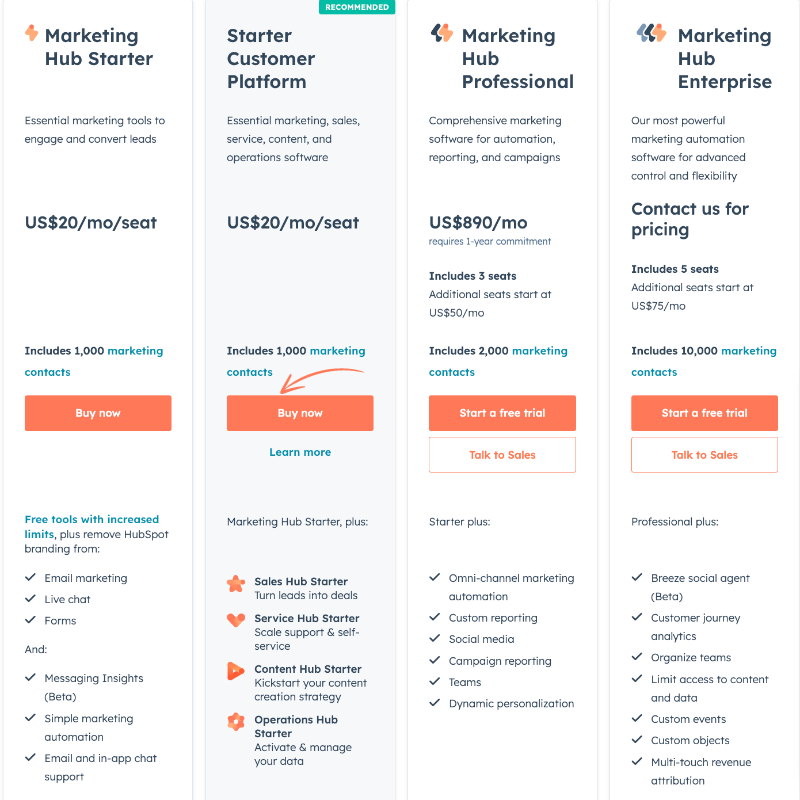
HubSpot provides a free CRM with no time limits. This allows startups and small businesses to start without financial risk. The free plan includes essential tools to manage contacts and marketing tasks.
Pardot, now known as Marketing Cloud Account Engagement, does not offer a free tier. Its entry-level plans start at a higher price point, making it less accessible for smaller businesses or those with tight budgets.
| Platform | Entry-Level Price | Accessibility |
|---|---|---|
| HubSpot | Free (CRM) | Highly accessible for small businesses |
| Pardot | Starting from mid-range pricing | Less accessible for startups |
Cost Structure For Mid-market And Enterprise Users
HubSpot offers tiered plans with increasing features and users. Pricing scales based on contacts and marketing needs. Mid-market and enterprise users can choose between Starter, Professional, and Enterprise plans.
Pardot’s pricing is structured around user licenses and feature bundles. It mainly targets larger businesses with deeper marketing automation needs. Costs increase with added features like AI and advanced analytics.
- HubSpot: Transparent pricing, flexible for growth.
- Pardot: Higher base price, focused on advanced enterprise features.
Value For Money: Features Versus Price
HubSpot delivers a broad range of features even at lower price points. The free CRM alone offers contact management and basic automation. Paid tiers add integrations, ad management, and reporting tools.
Pardot’s strength lies in deep Salesforce integration and complex automation. Its advanced tools suit companies needing sophisticated marketing workflows. The higher price reflects this focus.
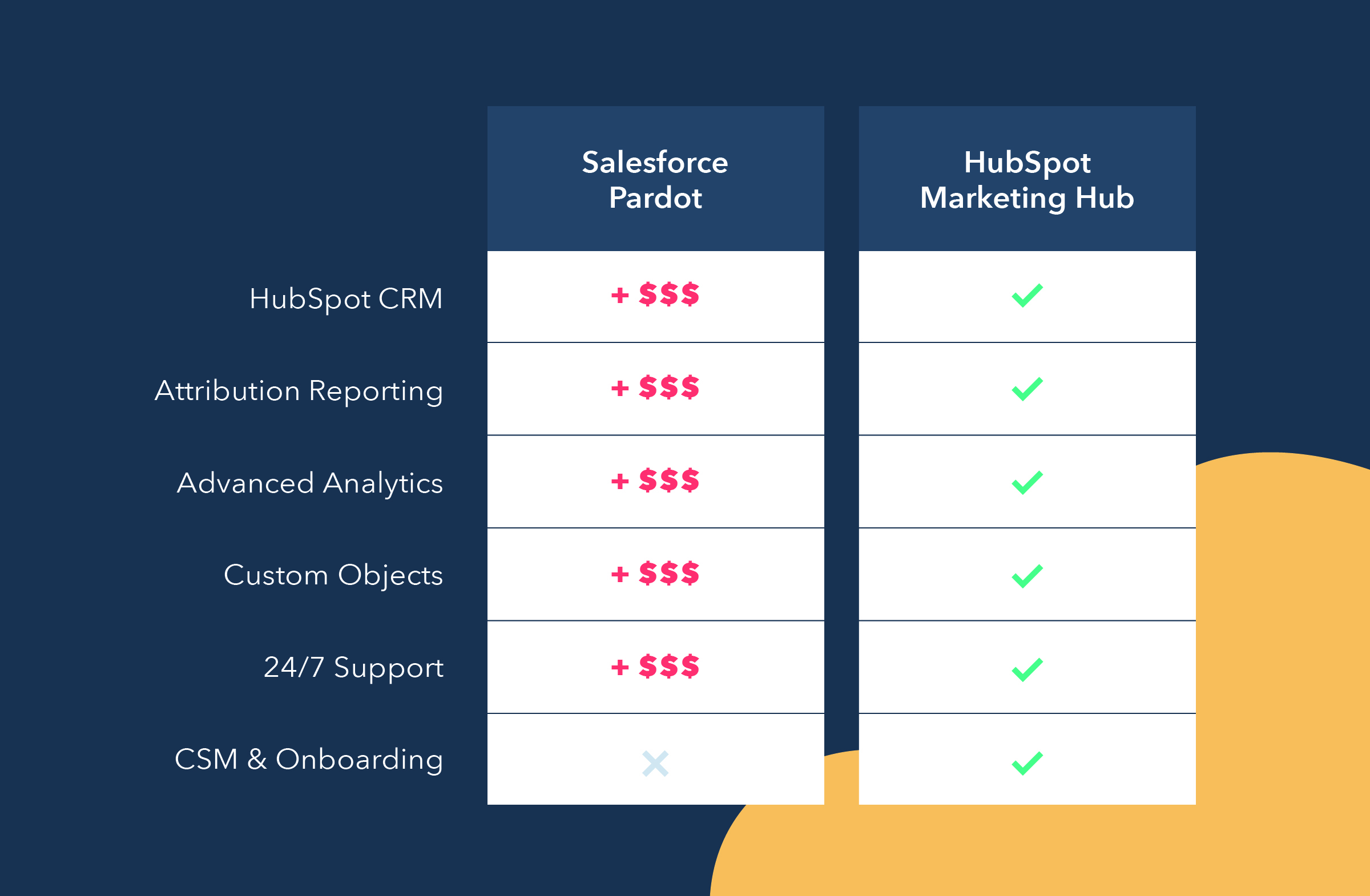
| Aspect | HubSpot | Pardot |
|---|---|---|
| Basic Features | Free CRM, contact management, marketing tools | Limited to paid plans, no free CRM |
| Advanced Features | Marketing automation, ad integration, analytics | Deep Salesforce integration, AI, advanced automation |
| Price Impact | Cost-effective for most users | Higher cost justified by enterprise features |
Credit: makewebbetter.com
Pros And Cons Based On Real-world Usage
Choosing between HubSpot and Pardot depends on your company’s size, goals, and tech environment. Both tools offer powerful marketing automation but differ in features and ease of use. Real users report unique benefits and challenges for each platform. This section breaks down those insights to help you understand their strengths and limitations.
Advantages Of Hubspot For Smbs And Mid-market Companies
HubSpot stands out for small and mid-sized businesses (SMBs). It combines a user-friendly CRM with marketing tools in one platform. Many users praise its intuitive interface and quick setup.
- Cost-effective: HubSpot offers a free CRM with no expiration, lowering entry barriers.
- All-in-one platform: Marketing, sales, and service tools work seamlessly together.
- Strong integrations: Connects easily with social media and advertising platforms, improving marketing insights.
- Easy automation: Simple workflows help automate tasks without coding skills.
- Support and resources: HubSpot Academy offers extensive training for users.
Strengths Of Pardot Within The Salesforce Ecosystem
Pardot is deeply integrated with Salesforce CRM, making it ideal for companies already using Salesforce products. Users benefit from powerful B2B marketing automation features.
- Seamless Salesforce integration: Data syncs smoothly between Pardot and Salesforce CRM.
- Advanced lead scoring: Helps sales teams prioritize leads effectively.
- Robust reporting: Offers detailed campaign and ROI analytics inside Salesforce.
- Account-based marketing: Supports complex B2B campaigns targeting specific accounts.
- Customizable engagement programs: Allows tailored nurturing workflows.
Common Challenges And Limitations Of Hubspot
HubSpot users note some limitations, especially as business needs grow. The platform can become costly when upgrading to advanced features.
- Pricing scale: Costs rise significantly with premium plans.
- Feature gaps: Some advanced B2B marketing tools are limited.
- Data limits: High contact volumes may require expensive add-ons.
- Customization: Less flexible than Pardot for complex campaigns.
- Learning curve: Though simple, mastering all features takes time.
Potential Drawbacks And Learning Curve Of Pardot
Pardot’s power comes with complexity. Users often mention a steeper learning curve and setup challenges.
- Complex setup: Requires Salesforce knowledge for smooth integration.
- Higher cost: Pricing can be prohibitive for smaller businesses.
- User interface: Less intuitive compared to HubSpot.
- Brand changes: Pardot is now Marketing Cloud Account Engagement, causing some confusion.
- Support: Some users find Salesforce support slower and less personalized.
| Feature | HubSpot | Pardot |
|---|---|---|
| Best for | SMBs and mid-market companies | Salesforce users and B2B enterprises |
| Ease of use | Intuitive and beginner-friendly | Complex, requires Salesforce knowledge |
| Pricing | Free tier, scalable but costly at high levels | Higher starting costs, enterprise-focused |
| Integration | Strong with ads, social, and third-party apps | Deep Salesforce CRM integration |
| Customization | Good for standard marketing workflows | Highly customizable for complex campaigns |
Ideal Users And Scenarios For Pardot And Hubspot
Choosing between Pardot and HubSpot depends on your business size, goals, and existing tools. Both platforms serve marketing automation but target different user needs. Understanding ideal users and scenarios helps pick the right CRM and marketing tool.
When To Choose Hubspot: Growth, Ease, And Inbound Marketing
HubSpot fits startups and small businesses aiming for steady growth. It offers an easy-to-use interface that simplifies marketing, sales, and customer service. HubSpot’s free CRM unifies all customer data on one platform, requiring no technical skills to start.
- Inbound marketing focus: HubSpot excels at attracting leads through content and social media.
- Simple setup: Quick onboarding for teams new to CRM and marketing automation.
- Cost-effective: A free CRM with no expiration supports small budgets.
- Better ad and social integration: Tracks marketing campaigns effectively.
- Strong integration ecosystem: Connects easily with many third-party apps.
Choose HubSpot if your business wants to grow with inbound strategies and values ease of use.
When Pardot Is The Better Fit: Salesforce-centric Enterprises
Pardot suits medium to large businesses deeply tied to Salesforce CRM. Since Pardot is now part of Salesforce Marketing Cloud Account Engagement, it integrates tightly with Salesforce sales data. This offers advanced B2B marketing automation for complex sales cycles.
- Salesforce integration: Native connection ensures smooth data flow.
- Enterprise features: Customizable automation for large marketing teams.
- Advanced lead scoring and nurturing: Supports long and complex sales processes.
- Focused on B2B: Designed for business-to-business marketing needs.
Select Pardot if Salesforce is your CRM backbone and you need deep automation for enterprise sales.
Scenarios Favoring Each Platform Based On Business Needs
| Business Scenario | Best Platform | Reason |
|---|---|---|
| Small startup with limited budget | HubSpot | Free CRM and easy setup support early growth |
| Company focusing on inbound marketing | HubSpot | Strong tools for content, social, and lead capture |
| Large B2B enterprise using Salesforce CRM | Pardot | Deep Salesforce integration and advanced automation |
| Marketing team needing complex lead scoring | Pardot | Customizable lead management fits long sales cycles |
The Future Of Marketing Automation: Ai And Platform Evolution
Marketing automation is rapidly changing with advances in artificial intelligence (AI) and platform improvements. AI now helps businesses understand customer data better and automate complex tasks. Platforms like HubSpot and Salesforce Marketing Cloud Account Engagement are evolving to meet new marketing needs. These changes make campaigns smarter and more efficient.
The focus is on using AI to deliver personalized customer experiences and improve sales results. Both platforms are integrating AI tools to help marketers save time and make better decisions. The future points to more automation, easier data management, and deeper insights into customer behavior.
How Ai Is Enhancing Hubspot’s Marketing Automation
HubSpot uses AI to simplify customer relationship management (CRM) and marketing tasks. Its AI features include:
- Automatic data organization for clearer customer views
- Predictive lead scoring to identify high-value prospects
- AI-powered content suggestions for blogs and emails
- Chatbots that handle customer questions 24/7
HubSpot’s AI tools help small businesses run campaigns without large teams. The platform offers a free CRM that stays free, making AI accessible to startups. This lowers entry barriers and supports growth with smart automation.
Salesforce Marketing Cloud Account Engagement’s Ai Developments
Formerly known as Pardot, Salesforce Marketing Cloud Account Engagement has integrated AI to boost B2B marketing. Key AI features include:
- Einstein AI for lead scoring and behavior prediction
- Automated email personalization based on customer data
- AI-driven analytics for campaign performance insights
- Integration with Salesforce CRM for seamless data flow
Salesforce focuses AI on deeper data analysis and sales alignment. It helps marketers target prospects more accurately and improve engagement rates.
Trends And What Marketers Can Expect Moving Forward
Marketing automation will continue evolving with AI at its core. Expect these trends:
- Greater personalization: AI will create even more tailored messages.
- Improved integration: Platforms will connect with more apps and tools easily.
- Automation of routine tasks: Marketers will spend less time on manual work.
- Real-time analytics: Instant data will guide faster decisions.
- Voice and visual AI: New ways to interact with customers will emerge.
Marketers can expect tools to become smarter and simpler to use. AI will help uncover hidden customer needs and optimize marketing efforts continuously.
Conclusion: Making The Right Choice For Marketing Success
Choosing between Pardot and HubSpot shapes your marketing future. Both platforms offer strong tools, but their fit depends on your needs. Understanding key differences helps in selecting the best solution for your business.
Summary Of Key Differences And Benefits
| Feature | Pardot (Marketing Cloud Account Engagement) | HubSpot |
|---|---|---|
| Target User | Mid to large enterprises, Salesforce users | Startups, small to medium businesses |
| Pricing | Higher, complex pricing tiers | More affordable, includes a free CRM option |
| Integration | Best with Salesforce ecosystem | Wide range of integrations, strong ad and social media tools |
| User Experience | Requires more technical knowledge | Easy to use, intuitive interface |
| Marketing Tools | Robust B2B marketing automation | Comprehensive CRM + marketing automation |
HubSpot stands out for startups and small businesses due to ease of use and cost-effectiveness. Pardot fits companies deeply invested in Salesforce and complex B2B marketing.
Final Recommendations Based On Business Size And Goals
- Small Businesses & Startups: Choose HubSpot for its free CRM, simple setup, and broad marketing tools.
- Medium to Large Enterprises: Pardot suits businesses with Salesforce and advanced B2B marketing needs.
- Marketing Goals: For integrated social ads and performance insights, HubSpot offers better options.
- Budget Considerations: HubSpot’s pricing is generally more accessible for smaller teams.
Next Steps For Evaluating And Implementing Your Marketing Platform
- Define your marketing goals clearly before comparing features.
- Assess your current tech stack and check integration needs.
- Request demos from both HubSpot and Pardot (Marketing Cloud Account Engagement).
- Test user experience with trial versions or free CRM options.
- Plan your budget including setup, training, and monthly fees.
- Set a timeline for implementation with clear milestones.
Making a well-informed choice maximizes marketing success and team productivity.

Credit: www.sagemarketing.io
Frequently Asked Questions
Why Is Hubspot Better Than Pardot?
HubSpot offers an easier setup, better integration with ads and social media, and a more affordable, scalable pricing model than Pardot. Its all-in-one platform suits SMBs and mid-market businesses seeking seamless inbound marketing and sales alignment.
Is Pardot Being Discontinued?
Salesforce discontinued the Pardot brand and website. Pardot now operates as Marketing Cloud Account Engagement. The software remains but under this new name.
How Much Is Pardot Vs Hubspot?
Pardot (Salesforce MCAE) starts around $1,250/month; HubSpot Marketing Pro begins at $890/month. HubSpot offers more affordable entry and easier setup.
Who Is Hubspot’s Biggest Competitor?
HubSpot’s biggest competitor is Salesforce Marketing Cloud Account Engagement (formerly Pardot). Other key rivals include Zoho, Freshdesk, and Keap. These platforms offer strong CRM, marketing automation, and customer support features tailored for diverse business needs.
Conclusion
Choosing between Pardot and HubSpot depends on your business needs. HubSpot offers an easy-to-use CRM with strong marketing tools. It integrates well with ads and social platforms. Pardot, now part of Salesforce Marketing Cloud, suits Salesforce users better. HubSpot’s pricing is often more affordable for startups and small businesses. For a simple, all-in-one platform, HubSpot stands out. Explore HubSpot’s features and benefits here: HubSpot CRM for Startups & Small Businesses. Make your choice based on what fits your team best.