
Choosing the right CRM can feel overwhelming, especially when you’re trying to boost your startup or small business growth. You might be wondering: Should you go with Reply.io, known for its powerful outbound sales automation, or HubSpot, a comprehensive CRM platform that keeps all your customer data organized and accessible?
If you want a tool that not only simplifies your sales and marketing but also fits your budget and grows with you, this comparison is for you. Keep reading to discover which platform matches your unique needs and how HubSpot’s free CRM could be a game-changer for your business. Ready to see what makes HubSpot stand out? Check it out here: HubSpot CRM for Startups & Small Businesses.
Credit: reply.io
Introduction To Reply.io And Hubspot
Choosing the right sales tool can change how businesses manage customer relationships and sales processes. Reply.io and HubSpot are two popular platforms that serve different but overlapping needs. Understanding their core functions helps businesses pick the best fit for their sales goals.
Overview Of Reply.io And Its Purpose In Sales Automation
Reply.io focuses on sales automation, especially for outbound sales teams. It offers tools to automate email outreach, calls, and follow-ups across multiple channels.
- Automates personalized outreach sequences
- Supports multi-channel communication including emails and calls
- Tracks lead engagement and reply rates
- Designed to save time and improve sales team productivity
Reply.io helps sales teams connect with prospects faster and more efficiently by automating repetitive tasks.
Hubspot: A Comprehensive Crm And Marketing Platform
HubSpot is a full-featured CRM platform built for startups and small businesses. It centralizes customer data and supports marketing, sales, and service functions.
| Feature | Description |
|---|---|
| Customer Relationship Management (CRM) | Unifies all customer data on one platform |
| Marketing Tools | Email marketing, lead capture, and campaign management |
| Sales Automation | Sequences, lead tracking, and pipeline management |
| Free Plan | 100% free CRM with no expiration |
HubSpot integrates marketing and sales activities to provide a seamless experience for users.
Why Compare Reply.io And Hubspot For Sales Success?
Both platforms target sales growth but in different ways. Reply.io centers on automating outbound sales with focused tools for outreach.
HubSpot offers a broader CRM and marketing ecosystem, ideal for managing overall customer relationships and inbound sales.
- Reply.io suits teams needing efficient outbound automation
- HubSpot fits businesses wanting an all-in-one CRM and marketing solution
- Budget and feature needs vary between the two platforms
Comparing them helps businesses choose the right tool for their specific sales strategy.

Credit: www.klenty.com
Key Features Of Reply.io And Their Benefits
Reply.io offers a robust set of features that simplify outbound sales and improve engagement. Its tools focus on automating outreach, enhancing email deliverability, integrating smoothly with CRM systems, and providing rich analytics. These features help sales teams save time, improve response rates, and make smarter decisions based on data.
Multichannel Outreach And Automated Sequences: Enhancing Outbound Sales
Reply.io enables outreach across multiple channels including email, phone, and social media. Users create automated sequences that send personalized messages at specific intervals. This approach keeps prospects engaged without manual follow-ups.
- Supports email, calls, LinkedIn, and SMS outreach
- Builds tailored sequences for different buyer personas
- Saves time with automatic follow-up messages
- Improves engagement rates through timely communication
Automation reduces human error and ensures no lead is forgotten.
Deliverability And Inbox Warm-up Tools: Improving Email Placement
Reply.io includes tools to improve email deliverability and protect sender reputation. The inbox warm-up feature gradually increases email sending volume. This builds trust with email providers and reduces the chance of landing in spam.
- Automates warm-up by sending genuine emails
- Monitors bounce rates and spam reports
- Optimizes sending schedules for best results
Better inbox placement means more prospects see your messages and respond.
Integration Capabilities: Seamless Data Synchronization With Crm Systems
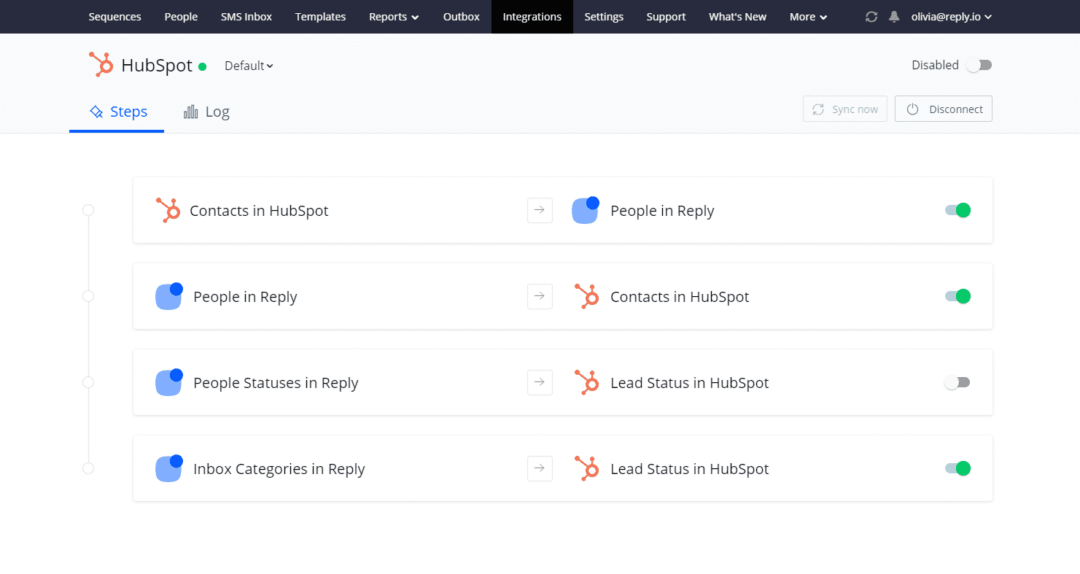
Reply.io connects smoothly with popular CRM tools like Salesforce, Pipedrive, and HubSpot. This ensures data synchronization between outreach activities and customer records.
| Integration | Benefit |
|---|---|
| HubSpot | Syncs contacts and tracks email engagement automatically |
| Salesforce | Updates lead status and logs communication in real-time |
| Pipedrive | Keeps sales pipeline current with outreach results |
These integrations avoid manual data entry and keep teams aligned.
Lead Tracking And Analytics: Data-driven Sales Insights
Reply.io provides detailed reports on outreach performance. Users can track open rates, reply rates, and call outcomes. Analytics help identify which messages and sequences work best.
- Visual dashboards show progress and bottlenecks
- Customizable reports for different team needs
- Enables quick adjustments to improve sales results
Data-driven insights let sales teams focus on the most promising leads.
Key Features Of Hubspot And Their Benefits
HubSpot offers a rich set of features designed for startups and small businesses. These tools simplify customer management, automate marketing and sales, and provide deep insights. The platform helps teams work smarter and close deals faster.
Comprehensive Crm Ecosystem: Centralizing Customer Relationship Management
HubSpot’s CRM system centralizes all customer data in one place. This eliminates the need for spreadsheets and scattered tools. Users can track contacts, deals, and interactions easily.
- Stores customer details, emails, calls, and notes
- Updates data in real-time for team-wide access
- Supports contact segmentation and pipeline management
This ecosystem helps teams stay organized and focused on building stronger customer relationships.
Inbound Marketing And Sales Automation: Nurturing Leads Effectively
HubSpot automates lead nurturing with email sequences, workflows, and personalized content. It helps convert visitors into customers by delivering timely messages.
- Automates follow-ups without manual effort
- Tracks lead behavior to trigger actions
- Integrates marketing and sales activities seamlessly
Automation saves time while making the lead journey smooth and consistent.
Advanced Reporting And Analytics: Monitoring Sales Performance
HubSpot provides detailed reports and analytics to measure sales and marketing success. Teams get clear visibility into performance and trends.
| Feature | Benefit |
|---|---|
| Customizable dashboards | Track key metrics at a glance |
| Sales funnel analysis | Identify bottlenecks and improve conversion |
| Revenue and activity reports | Measure team productivity and results |
These insights help optimize strategies and boost sales effectiveness.
User-friendly Interface And Extensive Integrations: Streamlining Workflow
HubSpot’s interface is intuitive for users of all skill levels. It integrates with many popular tools to create a smooth workflow.
- Simple navigation with clear menus and layouts
- Connects with email, calendar, social media, and more
- Supports third-party apps via HubSpot App Marketplace
This ease of use reduces training time and enhances daily productivity.
Pricing And Affordability Comparison
Choosing the right CRM depends heavily on pricing and affordability. Understanding the cost structure helps small businesses and startups make informed decisions. Both Reply.io and HubSpot offer pricing tailored to different needs. This section breaks down their pricing models and compares the overall value.
Reply.io Pricing Structure: Budget-friendly Options For Small To Mid-sized Teams
Reply.io offers a simple, flexible pricing plan designed for small to mid-sized sales teams.
- Starter Plan: Ideal for individuals or small teams, starting at
$70 per user/month. - Professional Plan: Includes advanced automation and analytics, priced at
$90 per user/month. - Custom Enterprise Plan: Tailored solutions with dedicated support and integrations.
These plans focus on outbound sales automation and multichannel outreach. Reply.io keeps pricing straightforward with no hidden fees, helping teams stay within budget.
Hubspot Pricing Tiers: From Free Tools To Enterprise Solutions
HubSpot provides a broad range of pricing tiers, starting with a free CRM that never expires.
- Free CRM: Unlimited users, basic contact management, and email tracking at no cost.
- Starter Plan: Starts at
$50/monthfor two users, adding simple automation and support. - Professional Plan: Costs
$800/month, includes marketing automation and advanced reporting. - Enterprise Plan: Customized pricing for large businesses needing full CRM capabilities.
This tiered structure suits businesses as they grow, but higher tiers come with a significant price increase.
Cost-benefit Analysis: Which Platform Offers More Value For Money?
| Feature | Reply.io | HubSpot |
|---|---|---|
| Starting Price | $70/user/month | Free (limited features) |
| Best for | Outbound sales teams focusing on automation | Broad CRM needs, from startups to enterprises |
| Automation Tools | Included from the base plan | Available only in higher tiers |
| Scalability | Good for small to mid-sized teams | Highly scalable with advanced features |
| Support & Integrations | Available in paid plans, focused on sales | Extensive integrations, support varies by plan |
Reply.io offers more affordable, targeted features for sales outreach. HubSpot suits businesses needing a full CRM with marketing and sales tools but at a higher cost.
Pros And Cons Based On Real-world Usage
Choosing between Reply.io and HubSpot depends on specific business needs. Each platform offers unique advantages and some drawbacks. Real users highlight different strengths and limitations that affect daily operations. Understanding these factors helps in selecting the right tool for sales and CRM management.
Strengths Of Reply.io: Outbound Sales Focus And Deliverability
Reply.io specializes in outbound sales automation. It streamlines cold emailing, follow-ups, and multi-channel outreach, making it ideal for sales teams focused on lead generation.
- High deliverability rates ensure emails land in inboxes, not spam folders.
- Easy setup for sales sequences saves time.
- Supports calls, emails, and social touches in one platform.
- Budget-friendly compared to many competitors.
This focus helps sales reps connect with prospects faster and more reliably.
Limitations Of Reply.io: Integration Challenges And Feature Scope
Reply.io has some integration issues with popular CRM systems. Users report occasional syncing delays and limited third-party app support.
- Lacks deep CRM features like contact management and pipeline tracking.
- Not suited for companies needing an all-in-one marketing and sales platform.
- Feature set is narrower, mainly supporting outbound outreach only.
Teams requiring broader marketing tools or seamless CRM integration may find Reply.io limiting.
Strengths Of Hubspot: Comprehensive Crm Features And Marketing Tools
HubSpot offers a full CRM solution with marketing, sales, and customer service tools in one system. It helps manage contacts, track deals, and automate marketing campaigns.
- Free CRM with no expiration supports startups and small businesses.
- Built-in AI provides data insights and customer behavior analysis.
- Marketing automation includes email campaigns, social media, and lead nurturing.
- Strong integration ecosystem connects with many apps and platforms.
HubSpot suits teams needing a unified system for managing customer relationships and marketing efforts.
Limitations Of Hubspot: Higher Cost And Complexity For Small Teams
HubSpot’s advanced features come with higher costs beyond the free tier. Small teams may find pricing steep as needs grow.
- Learning curve can slow adoption for users new to CRM systems.
- More complex setup compared to focused tools like Reply.io.
- Some features require paid plans, increasing expenses.
Small businesses with simple sales processes might prefer less complex, more affordable tools.
Ideal Users And Scenarios For Each Platform
Choosing the right sales and marketing tool depends on your team size, goals, and workflow. Reply.io and HubSpot serve distinct user needs. Each platform fits specific scenarios that help businesses grow effectively. Understanding these ideal users and situations guides better decisions.
When To Choose Reply.io: Small Sales Teams Focused On Outbound Outreach
Reply.io suits small sales teams aiming to boost outbound outreach. It offers powerful email automation and multichannel sequences that streamline prospecting efforts.
- Teams with limited budgets
- Focus on cold emails, calls, and LinkedIn messaging
- Need for easy-to-use outreach sequences
- Desire for detailed lead tracking and analytics
The platform helps sales reps save time by automating follow-ups. Its simple interface supports quick learning and deployment. Reply.io is ideal when outbound sales activities dominate your strategy.
When Hubspot Is The Better Fit: Businesses Needing An All-in-one Crm And Marketing Hub
HubSpot fits startups and small businesses wanting a complete CRM and marketing solution. It unifies all customer data on one platform for easy management.
- Teams needing a free CRM with no time limits
- Desire for integrated marketing, sales, and service tools
- Focus on inbound marketing and customer relationship management
- Use of AI features to understand customer data better
HubSpot’s broad capabilities support growth beyond just outreach. It helps track leads, manage pipelines, and run marketing campaigns without juggling multiple tools.
Use Cases Highlighting The Strengths Of Each Tool
| Scenario | Reply.io Strengths | HubSpot Strengths |
|---|---|---|
| Cold Outreach Campaigns | Automated multichannel sequences, easy follow-ups | Basic outreach; better for inbound marketing support |
| Lead and Customer Data Management | Good lead tracking and analytics | Comprehensive CRM with centralized data and AI insights |
| Marketing Automation | Limited marketing automation tools | Full marketing hub with email, social, and content tools |
| Budget Considerations | More budget-friendly for outbound sales teams | Free CRM with scalable paid plans for growth |
Conclusion: Making The Right Choice For Sales Success
Selecting the right sales platform shapes your team’s efficiency and growth. Both Reply.io and HubSpot offer strong tools but serve different needs. Understanding their core strengths helps match the platform to your sales goals and budget.
Summary Of Key Differences And Benefits
| Feature | Reply.io | HubSpot |
|---|---|---|
| Primary Focus | Outbound sales automation and multichannel sequences | CRM with unified customer data and AI insights |
| Best For | Sales teams needing budget-friendly, automated outreach | Startups and small businesses wanting a free CRM |
| Automation | Advanced email automation and lead tracking | Basic sequences with CRM integration |
| Pricing | More affordable, tailored to outbound sales | 100% free CRM with no expiration |
| Integration | Some integration challenges reported | Smoother integration and better analytics |
How To Align Platform Choice With Sales Goals And Budget
Define your sales priorities clearly. Ask:
- Is outbound outreach your main focus?
- Do you need a CRM to organize customer data?
- What budget do you have for sales tools?
Choose Reply.io for automated, multichannel outreach within a limited budget. Pick HubSpot to manage customers and sales pipelines with a free, easy-to-use CRM.
Consider team size and technical skill. HubSpot’s interface suits small teams new to CRM. Reply.io fits teams ready for advanced sales automation.
Final Recommendations For Sales Teams Evaluating Reply.io And Hubspot
- Start with a clear list of sales objectives and budget limits.
- Test HubSpot’s free CRM to explore customer data management.
- Try Reply.io if outbound sales automation drives your growth.
- Check integration needs with other tools your team uses.
- Evaluate user feedback on ease of use and support quality.
Focus on tools that simplify workflows and improve outreach success. Both platforms have strengths; choose the one that fits your team’s unique needs best.

Credit: reply.io
Frequently Asked Questions
What Are The Main Differences Between Reply.io And Hubspot?
Reply. io focuses on outbound sales automation with multichannel sequences. HubSpot offers a comprehensive CRM for inbound marketing, sales, and customer service. Reply. io is budget-friendly, while HubSpot provides a wider ecosystem of tools and integrations.
Which Tool Is Better For Email Automation?
Reply. io excels in email automation and lead tracking with advanced analytics. HubSpot provides basic email automation as part of its larger CRM platform. For robust outreach automation, Reply. io is often preferred.
Can Reply.io Integrate With Hubspot Crm?
Yes, Reply. io integrates seamlessly with HubSpot CRM. This integration syncs customer data and ensures relevant, timely messaging for sales and marketing teams. It enhances workflow efficiency by combining both platforms’ strengths.
Is Reply.io More Cost-effective Than Hubspot?
Generally, Reply. io is more budget-friendly compared to HubSpot. It offers powerful outbound sales tools at a lower price, making it ideal for small to medium businesses focusing on sales automation.
Conclusion
Choosing between Reply.io and HubSpot depends on your business needs. Reply.io focuses on outbound sales with affordable automation tools. HubSpot offers a full CRM platform that unifies customer data easily. It suits startups and small businesses wanting a simple, free CRM with no time limits. Both have strengths, but HubSpot’s integration and AI features stand out. Explore HubSpot’s CRM features at https://saaslabpro.com/hubspot to see if it fits your workflow. Make a choice that helps your team work smarter and grow better.